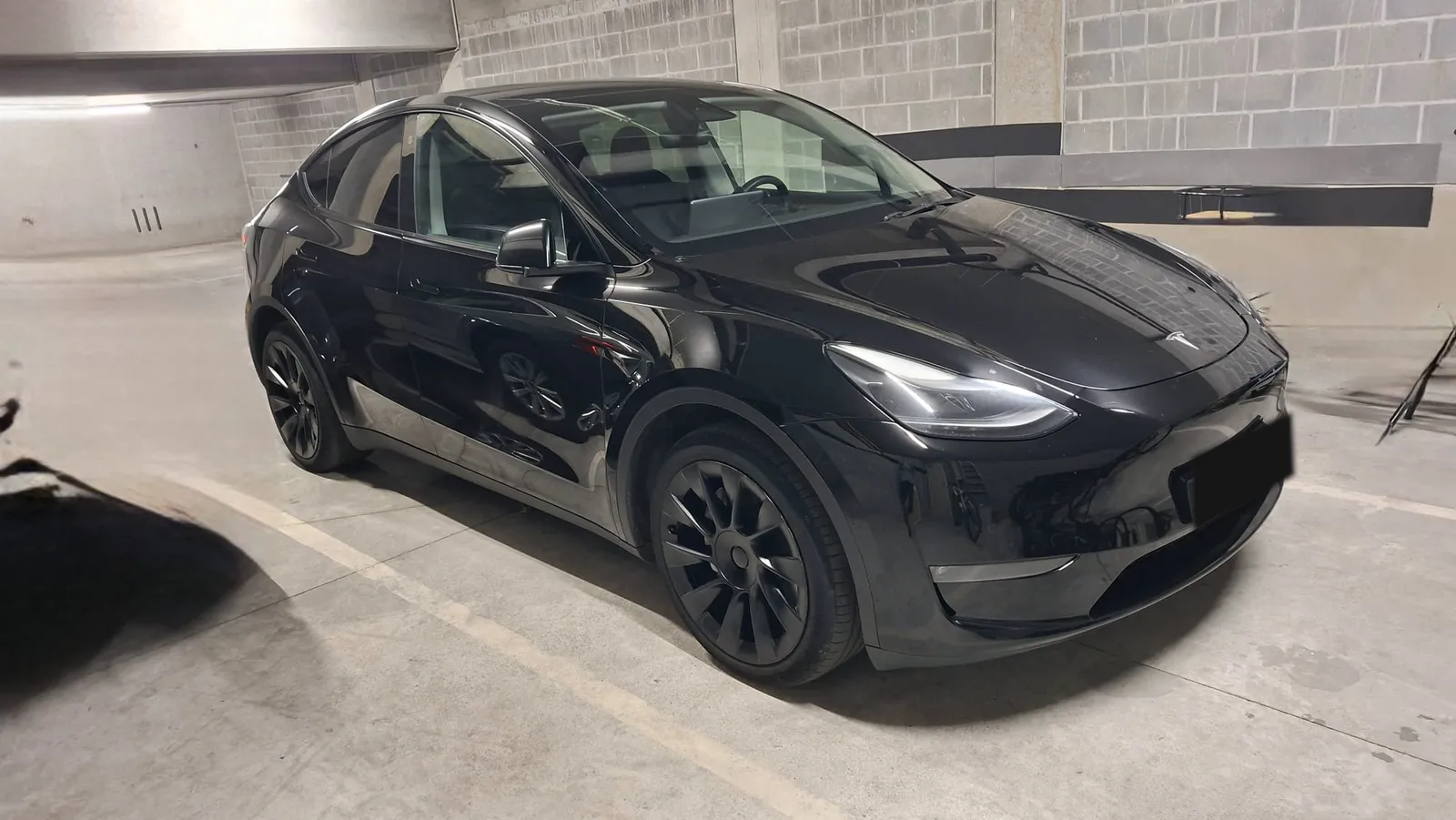
There are several ways to find out how much capacity a used Tesla battery has left. We put two of them side by side on the same 2022 Model Y at 258,718 km: Tesla's own Battery Health Test, run in the car, and a KeyTelemetry report, which reads the estimate Tesla already keeps. Here's how they compare, with the screenshots.
The options
- Tesla's Battery Health Test. Built into the car. It drains and recharges the battery to measure it.
- A report based on Tesla's own estimate, like ours. Read remotely, with the owner's permission.
- A Tesla Service Center check, usually when there's a fault or a warranty question.
- Independent diagnostic tests at a garage or with a plug-in tool, often combined with a test drive.
- Rough self-checks, such as comparing the range shown at 100% with the range when new. Quick, but easily skewed by temperature and driving style.
The first two need no workshop visit, so they're the easiest to do. Those are the two we compared.
At a glance
| KeyTelemetry report | Tesla's Battery Health Test | |
|---|---|---|
| Result on our car | 84.9% | 84% |
| How it works | Reads the battery estimate Tesla's software already keeps, through Tesla's official interface | The car empties and refills the battery and measures the energy |
| The battery | Not touched | Discharged to 0%, then charged to 100% |
| Time | A few minutes to connect. The PDF follows after our check | Up to 24 hours, car parked and plugged in |
| The car meanwhile | Usable as normal | Out of use. Climate control off |
| What you get | A dated PDF with VIN, odometer, usable kWh, estimated warranty status and a verification code | A percentage in the car and the app |
| Can a buyer check it? | Yes, online with the report number and check code | Only from a screenshot |
| Cost | €29.99 including VAT | Free, plus the electricity |
The results side by side
Tesla's background estimate, read before the test, came out at 84.9%. The dedicated test said 84%. That's a difference of 0.9 percentage points on a battery that has covered more than a quarter of a million kilometres. The report took minutes; the test took the car out of use for most of a day.
How Tesla's test works
You start the test from the touchscreen with an AC charger connected. The car then empties the battery completely, recharges it to full, and works out how much energy the battery holds compared with when it was new. While it runs, climate control is off, nobody should stay in the car, and you're asked not to use the car or the Tesla app.
The Tesla app shows each stage
Once the battery was empty, the car started recharging at 13:11 on 14 November. The charger recorded 68.1 kWh over 7 hours 46 minutes until the car ended the session, and the 84% result appeared shortly after. That figure includes normal charging losses, so it isn't a capacity measurement in itself, but it fits a battery that holds about 66 kWh.
How the report works
Your Tesla continuously estimates its own battery health as it's driven and charged, but it doesn't show that figure in the car or the app. A KeyTelemetry report reads it. You connect your Tesla account by signing in on Tesla's own page, choose the car and allow read access. We read the estimate, check the result and email you a link to the PDF.
The report shows Tesla's figure unchanged, with the time Tesla last calculated it, plus usable capacity in kWh and where the car stands against the battery warranty. The warranty part is an estimate: the distance comes from the odometer, but the time left is worked out from the model year, because the exact start date depends on first delivery. Every report has a check code so a buyer can confirm online that it's genuine.
Where they really differ
- What's measured. The test measures the battery afresh through a full cycle. The report shows Tesla's running estimate, which the car updates during normal use. They're close but not identical: on our car, 0.9 points apart.
- What it costs you in time. The test needs the car parked and plugged in for up to a day, with the battery taken down to empty. The report needs a few minutes, and the car carries on as normal.
- What you can show someone. The test leaves a percentage on a screen; a screenshot proves little to a stranger. The report is a document tied to the VIN and odometer, and anyone can verify it.
- Warranty. The test says nothing about warranty. The report estimates where the car stands against Tesla's battery warranty. Neither is a warranty decision; only Tesla can make that.